
Facebook is a great place to meat great people with really great watches. 🙂 This is why we have created the Vintage Citizen Watches official group page. Check it out and add yourself and your friends! Here it is: https://www.facebook.com/groups/vintagecitizenwatches/354822734656228/?comment_id=354922047979630¬if_t=like  Thank you for looking!
Citizen diver

Citizen automatic diver 51-2273
Another vintage diver is the model 51-2273.
This one is more recent than the previously featured watches here.
 One of the main feature about this one, compared with the others, is the unidirectional rotating bezel. Also, the “Mercedes” hands are gone and are replaced with a different style.
The case is made in stainless steel, with a brushed (circular) front surface and polished sides. The case back screws in and it is polished too. This case features crown guards for protecting the crown, a nice diving detail that enhances the “tool watch” appearance. Another diving feature in the screw in crown and the unidirectional bezel. This time the bezel has 60 solid clicks and rotates only counter clock wise. On 12 it has a triangle with a luminous dot. Every 10 minutes are marked with numbers and every minute by lines. The overall size is perfect, at 40 mm diameters without the crown and 20 mm between lugs. The mineral crystal is flat.
The dial is mate black without any reflections. The hour markers are dots or lines, depending on the position. They are filed with luminous material. The hands are also luminous and they have a distinct shape, more geometrical, that I think enhance the overall look of the watch. On 12 there is the applied Citizen logo and “automatic”; on 6 there is the writing: “21 jewels – water resistant – 150 M ” On 3 there is the day-date window, in a single frame. The day is bilingual with red “Sunday” while rest are black.
 The movement is the well known automatic Citizen calibre 8200A (Miyota). It has 21 jewels and offers a hand winding capability. First position of the crown wind the watch, the second will change the day and the date (in different directions) and the third will set the time. It beats at 21,600 bph and has a power reserve of 43 hours. The rotor will wind the watch in one direction only. Nothing fancy about this, just a reliable, simple movement that is doing it’s job as it should.
The strap on this watch is a rubber one with a stainless steel clasp. Rubber fits it very well and next to the nato straps it is the best option for this model. The width at the lugs is 20mm so plenty of strap options are available at this size.
 Conclusion: A nice diver that has all the features of a real diver: unidirectional 60 clicks bezel, easy to read, mate dial with clear hour markers and hands, a sweeping central second hand, screw in crown protected by crown guards, a reliable simple automatic movement and a long rubber strap. A real tool watch!
Share this:

Vintage Citizen compressor style diver 4-520343 Y
Vintage Citizen divers – this time a compressor style. And what is better than one diver? Two divers, or even three!
A compressor case means that the bezel is not outside the case, but actually inside the case, under the crystal. It is not operated directly but with the turn of one of the two crowns. As Gray showed in the comment of this post these are not actually compressor cases, but actually compressor style inspired.
“These are beautful watches and I enjoyed reading about them but I must correct your assumption that they are compressor watches. Its a common misconception that if a watch has two crowns and an internal bezel, it must be a supercompressor but infact Compressor and Super Compressor watches are defines by the company which made the cases and held a patent for their design. These cases were made by the specialist manufacturer Ervin Piquerez S.A. of Switzerland. No Japanese manufacturer used EPSA Compressor cases. Information about Compressor cases is not hard to find. The link below shows the three types of Compressor case, including the Super Compressor from which your Citizen watches are inspired. True Super Compressors are typically identified by a crossed hatched design on the crowns, a diver helmet logo on the case back or inside the case back, but always, they have the brevet (patent) number on or inside the case back. http://wornandwound.com/2014/03/24/guide-super-compressors/” – Is the comment from Gary. Thank you for the clarification!

This particular model is one of the early Citizen divers, with compressor style case. I have seen it in black dial, red, blue and silver dial. The red dial is one of the most beautiful dials ever. Actually is more a burgundy red. The blue is awesome in different lightning conditions, the black is subtle and classy and the silver is really special.
The case is larger than the usual divers of that era, but similar with other vintage Citizen. It is about 44mm, with a brushed frontal surface, with a radial pattern. The sides are polished. The lugs are well integrated in the overall design, with the same finish as the case. The two crowns are protected because the 9 o clock side (flat) and the 3 o clock side (angled) are not symmetrical, so the crowns are not sticking out a too much. They are signed “C”. The outer bezel that keeps the domed acrylic crystal in place is polished. The crown at 2 operates the inner bidirectional bezel, and sometimes is very easy to move it by accident so i prefer the models with an outer bezel. The crown at 4 winds the watch and sets the time and sometimes is hard to operate.
The dial is the best part of this watch. The red one is gorgeous, the blue is beautiful, the black is classic but the silver is not really at home for this model (IMHO) but it is rare and special.. In fact all the colors have a matching rotating bezel except for the silver one that has a black bezel. The black dial is flat, matte. The red and the blue one have thin black longitudinal stripes so the color gets a little darker. All of them have the cross hair lines. At 12 they have the polished applied Citizen logo and on 6 it is written “water 100M proof” “automatic” “21 jewels”. It is very interesting the fact that the dial is marked waterproof (sometimes parawater) and the caseback parawater. This is due to the fact that it was manufactured in an era when Citizen transitioned from parawater to water resistant. Also some of them were designated for export so a different marking was needed than the ones for domestic market. Read about this here: https://vintagecitizenwatches.com/2013/12/26/citizen-parawater-citizen-parashock/ The ones that have “waterproof” on the dial are for export. At 3 we have the day and date window, in a divided frame. The Sundays are in red lettering, the rest are black. The hour markers are trapezoidal, applied with a polished frame, jus as the date frame. The hands are the usual “Mercedes” type and the second hand has the luminous tot at the very end of it. One rare model has straight hour hand, matching the minute one. For a long time I thought it might not be original but thanks to Pawel I now saw the model in real life and it is for sure 100% original. I also saw one picture from a German catalogue on Stephen‘s blog who says: “There was also a version of this model, maybe only an export version, that had a straight hour hand, rather than the ‘Mercedes’ type. At the moment this image, from a German brochure (with credit to ‘Axel’ on the old SCWF site) is the only one I have seen.” Thanks Pawel for the pictures of the straight matching hands one! Great watch! After 40 years, the luminous material still glows beautifully at night. The rotating bezel is rather shiny, with a luminous dot inside a triangle at 12, and painted numbers every 10 minutes. The rest of the minutes are dots and every 5 minutes we have a rectangle. Great quality for this bezels. You have to see them in real life to fully appreciate them!

Here it is another straight hour hand piece, a black dialed one. Thank you Christian for the pictures!

And a pic that I like:

The movement is the automatic Citizen calibre 5270, with 21 jewels, (and a black rotor that I like a lot). It is a common movement used in a variety of models, not only divers. This means that replacing parts are easy to source. It is reliable and offers hand winding possibility. The date changes in the second position of the winding crown (first position for winding, third for time setting) but the day changes only by passing midnight with the hands. The operating crown for the movement is the one at 4.
The strap I’ve seen is most of the times a replacement one. Sometimes I have seen them on Citizen or replacement stainless steel bracelet, sometimes on rubber, nato or even leather. They can take any type you want to throw on them. I keep them on matching nato straps, red for red, black for black. This way they are really comfortable and I thing a Nato suits them well. The width at the lugs is 20mm.
 Conclusion: Just as most Citizen divers – wonderful, easy to wear, a pleasure to look at, modern and vintage at the same time… timeless beauty!
Read abut my favorite Citizen diver here: https://vintagecitizenwatches.com/2013/12/24/citizen-automatic-diver-150m-52-0110/
Share this:

Citizen Parawater – Citizen Parashock
The term “Parawater” was the one used by Citizen to describe that the watch was water resistant.
In 1959 the company produced the first Japanese water-resistant wrist watch. This was the “Citizen Parawater”. It was powered by the Citizen Cal. 920(2B). Soon after, the Parawater completed two trans-Pacific tests and one in the Sea of Japan. The result, needless to say, was positive. As time passed Citizen was growing as a company and exported more and more watches, so the term “Parawater” was changed to the universally recognized “Water resistant” somewhere around 1970-1973.
Read more about Citizen diving watches here: https://vintagecitizenwatches.com/diver-vcw/

The term “Parashock” came to life in 1956 when the company produced the first shock-proof Japanese watch, known as the “Parashock”. So first was the “Parashock” and three years later the “Parawater”.
Even though you have a parashock and a parawater watch, please don’t treat it as a modern Casio G-shock. 🙂
Share this:

Citizen History from 1918
The Mayor of Tokyo, Mr Shimpei Goto, named the watch “CITIZEN” with the hope that the watch, a luxury item of those times, would become widely available to ordinary citizens and be sold throughout the world. He got this right.

The official table (from official Citizen website):
| Year | Month | Event |
|---|---|---|
| 1918 | 3 | Shokosha Watch Research Institute established, the forerunner of Citizen Watch Co., Ltd. |
| 1924 | 12 | First pocket watch completed. |
| 1930 | 5 | Citizen Watch Co., Ltd. established. Yosaburo Nakajima appointed president. |
| 1931 | 6 | First wrist watch completed. |
| 1936 | 5 | Tanashi Factory constructed. |
| 1941 | 7 | Production of machine tools begins. |
| 1945 | 10 | Shinji Nakajima appointed president. |
| 1946 | 3 | Eiichi Yamada appointed president. |
| 1949 | 6 | Citizen Trading Co., Ltd. established. |
| 1952 | 3 | First Japanese-made watch with a calendar introduced. |
| 1953 | 3 | Rhythm Watch Co., Ltd. becomes an affiliate. |
| 1955 | 12 | Export of wrist watches begun. |
| 1960 | 3 | Import-export agreement concluded with the U.S. Bulova Watch Co. Technical assistance agreement with India. |
| 1964 | 8 | Technology research laboratory established. |
| 12 | Citizen Business Machines established. | |
| 1965 | 3 | Production of business machines begun. (Adding machines, camera shutters) |
| 10 | Office opened in former West Germany, start of full-fledged exports to Europe. | |
| 1966 | 3 | First Japanese-made electronic watch “X-8” introduced. |
| 1970 | 3 | CNC automated lathe “Cincom” developed. |
| 1971 | 6 | Precision Machinery Division established. |
| 1976 | 3 | Production of quartz oscillators begun. |
| 1978 | 2 | Head Office moved to Shinjuku Mitsui Bldg. in Tokyo. |
| 1980 | 6 | Industry’s first microcomputer controlled line impact printer introduced. |
| 1981 | 6 | Rokuya Yamazaki appointed president. |
| 10 | Systems and Peripherals Division established. | |
| 1982 | 9 | Special Sales Division established, full-fledged sales of watch components started. |
| 1983 | 3 | Chip LED lamp CL Series developed. |
| 5 | IC sensor electronic thermometer introduced. | |
| 1987 | 6 | Michio Nakajima appointed president. |
| 1990 | 1 | Citizen of the Year annual award established. |
| 1992 | 2 | Acquired German machine tool company, Boley GmbH. |
| 1993 | 5 | World’s first multizone “Radio-Controlled Watch” introduced. |
| 1996 | 4 | Solar-powered Eco-Drive received the Eco Mark the first for a watch. |
| 1997 | 6 | Hiroshi Haruta appointed president. |
| 2001 | 3 | Head Office moved to Nishi-Tokyo. |
| 2002 | 3 | Sales of white LED as a backlight for color LCDs started. |
| 6 | Makoto Umehara appointed president. | |
| 2003 | 6 | World’s first full metal case radio-controlled watch with built-in antenna introduced. |
| 2004 | 1 | Implemented Citizen Code of Conduct. |
| 10 | Merged with Citizen Trading Co., Ltd. | |
| 2005 | 4 | Citizen Systems Japan Co., Ltd. established. |
| 10 | Five consolidated companies (Citizen Electronics, Miyota, Cimeo Precision, Sayama Precision Industries, Kawaguchiko Precision) become wholly owned subsidiaries. Names of Citizen Group companies changed. | |
| 2007 | 4 | Company name changed to Citizen Holdings Co., Ltd. |
| 2008 | 4 | Mitsuyuki Kanamori appointed president. |
| 7 | Citizen Miyota Co., Ltd. and Citizen Finetech Co., Ltd. merge. Citizen Finetech Miyota Co.,Ltd. established. |
|
| 10 | Miyano Machinery Inc. becomes a consolidated subsidiary. | |
| 2011 | 4 | Citizen Machinery Co.,Ltd. and Miyano machinery Inc. merge. Citizen Machinery Miyano Co., Ltd. estabilished. |
| 2012 | 4 | Toshio Tokura appointed president. |
Source: http://www.citizen.co.jp
And a few additions from here: http://forums.watchuseek.com/member.php?u=15164
The forerunner to what we now know as The Citizen Watch Co. Ltd., began life in 1918 under the name Shokosha Watch Research Institute. Buoyed on by an ambitious Mayor who demanded that the Shokosha-Watch Institute should have a bearing on all citizens, in so far as “people appreciated and benefited from the institute’s results”. Prophetic words indeed – from this statement, the seeds were sown that would help produce the world’s largest watch manufacturer.
1920’s
In 1924, the first pocket watch to bear the Citizen moniker was produced.
One of these first products produced by the company was purchased by Emperor Showa, Prince Regent at the time (Emperor Taisho era).
1930’s
In 1930, Yosaburo Nakajima laid the foundations of the Citizen watch empire.
In 1931, a 10½ ligne caliber is in production, followed in 1935 by an 8 ¾.
1936 saw the company expand beyond the boundaries of Japan, exporting watches to many parts of Southeast Asia.
1940’s
In 1940 a 5 1/4 ligne caliber was introduced. During World War Two, Citizen moved their production facilities to a small town 200km from their former location in Tokyo. The company manufactured many components, amongst which were chronometers and igniters for military use.
1949 saw the creation of The Citizen Trading Company. This entity controlled the distribution and marketing of Citizen watches throughout the world.
1950’s
In the early part of 1950’s, Citizen completed Cal. 960(M), its first 6 beat caliber with 17 jewels, and Cal. C, Japan’s first men’s wrist watch fitted with date display known as “Citizen Calendar”. In 1953, Citizen acquired a clock manufacturer, The Rhythm Clock Co. (currently named “The Rhythm Watch Co., Ltd”), as an affiliated company.
1956 was a momentous year for the brand. The company produced the first shock-proof Japanese watch, known as the Parashock.
In 1958, the company produced its first automatic-winding wrist watch “Auto” fitted with Cal.3KA, and Japan’s first manual winding alarm caliber with 19 jewels, Cal.980(A). Also the introduction of “Citizen Deluxe” fitted with Cal.920, Citizen’s first caliber with central seconds, proves a hit with the watch buying public, with sales of over 100 million pieces.
In 1959, the company produced the first Japanese water-resistant wrist watch, the “Citizen Parawater”, Cal. 920(2B).
1960’s
At the start of the 1960’s, the Parawater completed two trans-Pacific tests, as well as one in the Sea of Japan – all passed with flying colors.
1960, Citizen signed an export/import agreement with USA’s Bulova Watch Company.
1962 saw the company introduce an officially certified chronometer and the world’s thinnest men’s wrist watch with center seconds, the “Diamond Flake”, Cal.0700.
The year 1963 heralded the introduction of the Quartz-transistor clock.
In 1964, pursuing a diversification strategy, Citizen founded the Citizen Office Machine Co., Ltd. (today’s Japan CBM Corporation).
In 1965, Citizen started producing office equipment and precision manufacture components.
In 1966, Citizen introduces Japan’s first electronically regulated balance wrist watch known as “X-8” or “Cosmotron”.
1967 saw the company put the world’s first quartz transistor clock into the market.
1970’s
The 70’s were another prolific decade for Citizen, and also the beginning of the company’s move towards the quartz technology that dominates its current output. However, Citizen did not completely move away from mechanical movements during this decade.
1970 saw the introduction of the world’s first Titanium cased watch “X-8 Chronometer”, followed by a tuning fork caliber a year later.
In 1972, Citizen evolved the 60’s “Sports Master”. They developed an brand new automatic chronograph, named the “Easter Rabbit” – commonly referred to by English speaking collectors as the “Bullhead” (or the “Panda” in Japan). The “Easter Rabbit” showcased calibre 8110, which included a zero-position reset mechanism fitted with a shock absorber.
In 1973, the company launches its first quartz wrist watch, fitted with Cal. 8810.
During 1974, Citizen signals its intent to seriously pursue quartz technology by introducing a quartz movement, Caliber 8600EX, fitted with Japan’s first stepping motor mechanism*.
By 1975, the launch of the now legendary Crystron Mega Quartz left the watch world with little, if any, doubt about where Citizen were heading as an brand. Fitted with caliber 8650, generating a frequency of 4,194,304Hz, it is still to this day one of the world’s most accurate (and priced at approx. Y15,000,000 one of the most expensive) wrist watches ever offered for public sale.
In 1975, The Citizen Watch Co. of America Inc. is established.
In 1974, solar powered technology is first introduced, not to mention the first Japanese LCD technology watch.
1978 saw the company introduce a 0.98mm thick quartz caliber, “Quartz 790”.
By 1978, the company moves to the Shinjuku Mitsui building in Tokyo, followed in November of that year with the release of the Citizen Quartz Digi-Ana, fitted with caliber 8900 – it featured a combination of digital LCD and analogous time indication.
1980’s
By 1980, Japan had become the world’s largest producer of watches and watch movements. November of this year brought the release of ladies wrist watches fitted with the world’s smallest volume movement, “The Exceed Gold”.
Towards the end of 1981, Citizen released their 1300m Professional Diver’s watch. At the time, it was the world’s most water resistant watch available for public use.
By 1982 the diversification that started in the 1960’s, saw Citizen produce the world’s largest Neon-Light advertisement installed in Hong Kong.
1985 saw the release of the world’s first watch fitted with a depth gauge, the “Sport Depth Meter”.
By 1986, Citizen becomes the world’s largest single manufacturer of watch movements.
In 1987, the company introduced the “Voice Master” or “Voice Memo” (in Japan)”, VX-2, the first wristwatch with voice recognition.
1990’s
The 1990’s were almost as significant and prolific in terms of world’s firsts than the 70’s were for the company. In the early 1990’s Citizen launched the Analog-Aqualand, the first quartz watch with an analog depth gauge.
In 1992 Citizen became the official timekeeper of the America’s Cup yacht race.
In 1993, Citizen introduces radio-controlled watches to the market place.
1995 saw two significant additions to the world of Horology: “The Citizen” was released in May, backed with a ten year factory warranty and +/- 5 second a year accuracy; and November saw the introduction of Eco-Drive power generating technology, which quickly became Citizen’s number one seller.
1996 was another busy year. Citizen’s Eco- Drive technology was awarded the first “Eco-Mark”, an officially certified Japanese award for environmental protection. In July Citizen released the world’s thinnest solar cell equipped movement, only 3.14mm thick.
In 1997, Citizen launches the “Exceed Eco-Drive” to the Japanese market, featuring accuracy of +/- 10 seconds per year, followed closely by “Eco-Drive Signature Technology”, which corrects time differences when traveling between time zones.
1998 saw the introduction of the “Promaster Eco-Drive Aqualand” or “Promaster Aqualand Eco-Drive Analog Depthmeter” (in Japan) , the world’s first solar powered diver’s watch with an electronic depth gauge. In October, Citizen unveil the world’s smallest quartz movement, fitted to the Exceed Lady’s Eco-Drive.
By the end of the millennium, Citizen introduced “Promaster Eco-Drive Super Tough”, which can survive/withstand/resist the shock of an impact hammer 5 times more than non para-shock watches.
2000’s
Thus far, during the decade of 2000, Citizen has:
– Relocated its headquarters to Nishi-Tokyo City;
– Founded the Lead-Free Committee;
– Founded the Eco-friendly product subcommittee and green purchasing subcommittee;
– Developed the world’ slimmest radio-controlled watch;
– Introduced automatic time keeping for marathon/ekiden races through the use of IC chips;
– Introduced the Campanola range of High End Quartz watches.
– Merged [with] Citizen Shoji;
– Acquired Miyota Co. Limited as a going concern, which included several small component manufacturing subsidiaries; and
– On January 10th 2008 Citizen acquired USA’s Bulova Watch Company, including all its affiliated brands (Bulova, Caravelle, Wittnauer and Accutron) for US$247 million, making the combined company the world’s largest watchmaker.
*EDIT – Switzerland’s Girard-Perregaux hold the record for the worlds first stepper motor equipped quartz wristwatch.
source: http://forums.watchuseek.com/f9/brief-history-citizen-watch-company-175421.html
REFERENCES:
Citizen Watch Co.
Citizen Watch Co. of America Inc.
History of CSR – Citizen Watch Co. Ltd
Citizen Watch Co. Ltd – Wikipedia
Watches for the World – Uhren Juwelen Schmuck – Author; Gisbert L. Brunner
www.citizen.com.hk/
www.citizenwatch.com
I would like to thank to all involved in putting together this information and I hope that the amount of known data that will be available will grow constantly.
Read more about the first Citizen here: https://vintagecitizenwatches.com/2014/09/27/citizen-shokosha-pocket-watch/
Share this:

Citizen automatic diver 150m – 52-0110
Vintage divers – every time I hear this combination of words my heart races a little.
I dream about that period in time when a watch was what it was supposed to be, a true tool watch, a real diving instrument, not a desk diver fashionable statement as it is most of the times today. Was it a good thing or a bad one, who am I to judge? But for sure I love a vintage diving tool watch such as this one I am talking today. Lucky me I have a NOS one, birth year and month 52-0110, and this is awesome. I love it!

The 150m Citizen is, in my opinion, one of the best looking vintage diver ever! It has everything a real diver should have: decent water resistance (150m), screw in crown and easy to use, screw in caseback, a diver bezel, clear indexes, easy to read hands contrasting with the matte dial, a sweeping central second hand, thick glass, diver extension clasp and the most important: a reliable movement. Wearing this watch makes me dream about the Ocean depths and underwater adventure. It looks good on original bracelet, on nato, on mesh bracelet, on rubber and even on a rugged leather strap. Beautiful watch!
The case is made of stainless steel, 40mm diameter, 13mm thick, brushed face and polished sides. It has thick lugs and it is rugged and powerful without being overwhelming. The perfect shape and size for a diver. The screw-in crown is easy to operate, and it is unsigned. The bezel is frictional type, bidirectional, easy to use but not so easy to mess with when underwater. Pay attention because most aftermarket bezels don’t have dots at every minutes. The lugs are 20mm apart accommodating most modern straps you throw at it. The mineral crystal looks like it is domed but in fact it is flat. The underside is actually concave bending the light in a mysterious way that makes me day dreaming. It sits at about the same height (or slightly higher) with the black bezel.
The dial is gorgeous. Plain, matte, deep black. There is no reflection. The reflection comes from the crystal and from the indexes and the hands. Not too much writing on the dial except the applied Citizen logo, automatic, 21 jewels, water resistant, 150m. At 3 we have the date window. Something about the date window – there are some variations here – with or without luminescent index at the side, in the same frame with the date, or in a separate frame. The luminescent material is glowing even more than 40 years later and has a superb green-yellow light to it.
The movement is the work horse 8210A, 21 jewels, automatic with hand winding capability. Not much to say about this, it is just a clean, easy to use and service, reliable movement. Nothing fancy, just a up to the job honest movement. It beats at 21.600 bph and has a quickset date. The first time this movement was used in this watch seems to be 1977. You can see the date of manufacture in the serial on the caseback. The first number is the year, the next two digits are for the month.
The bracelet is stainless steel, with “H” shaped links. Very comfortable. The clasp is also stainless steel, signed Citizen. It has a diver extension. The bracelet should be brushed. My NOS one came on the original Tropic strap with Citizen signed SS buckle. So… Tropic is original and bracelet is original too.
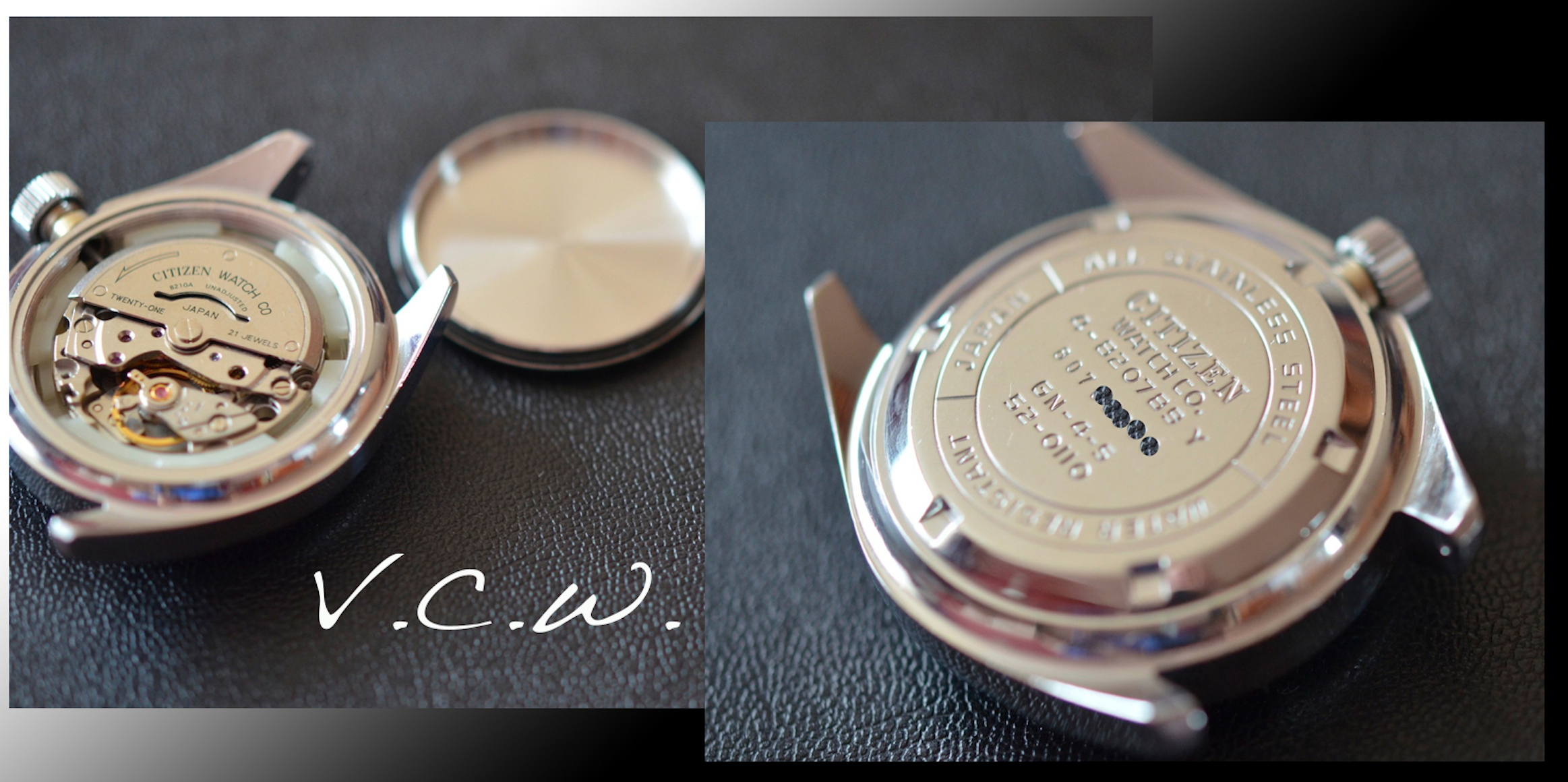
Update 2017 September: An orange dial one and a NOS 52-0110 with box and booklet with pictures from the online seller:

Not sure if both boxes are correct? They might be because there are quite a variations of 52-0110 models so I expect it for the boxes to be a little different too. Who knows?

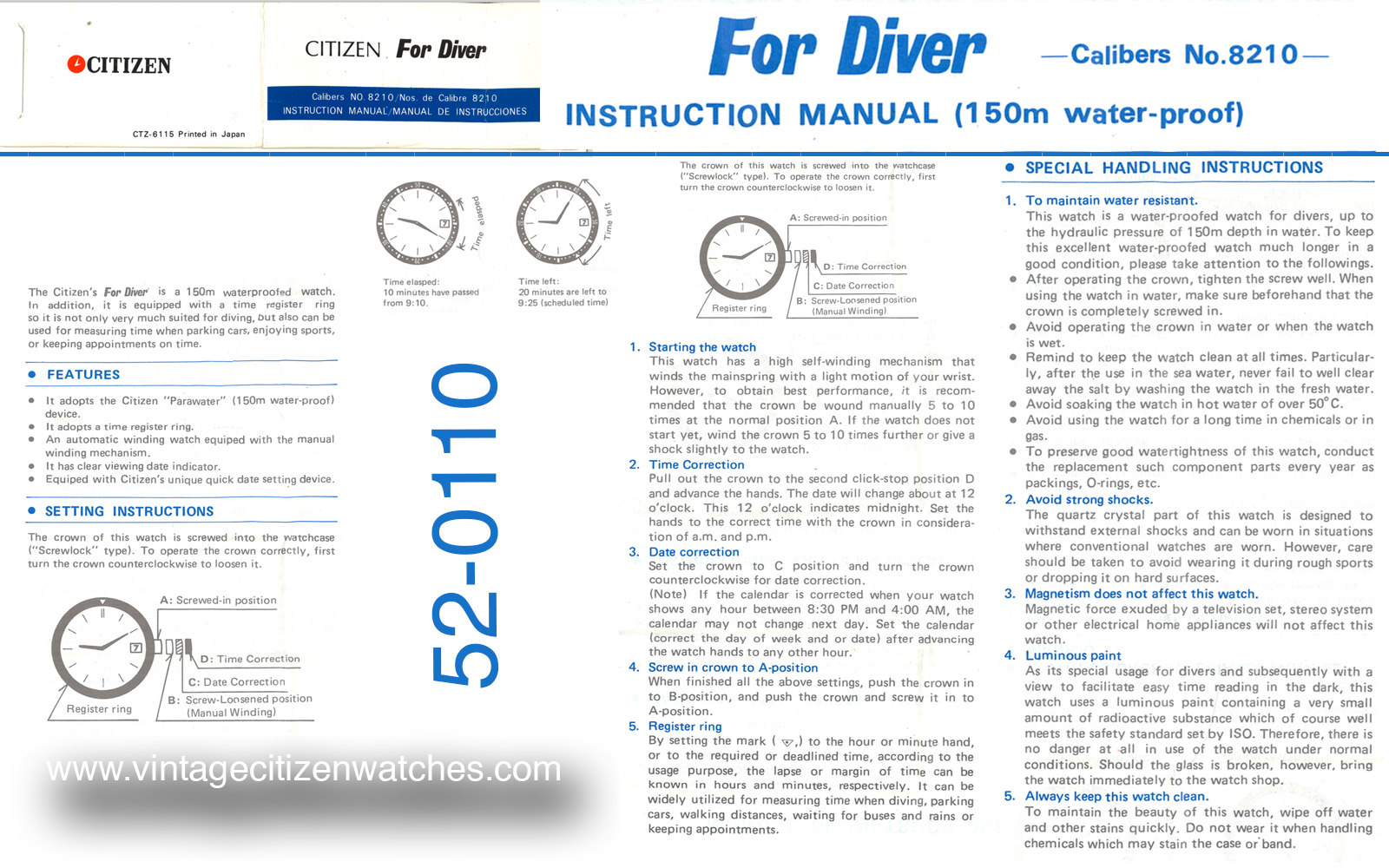
And here it is the booklet of the watch: Thank you Mikko and congrats on yours! Mikko’s booklet was in English and Spanish.
Conclusion: Beautiful, real diving watch, a time capsule that as soon as it is strapped on the wrist ticks away telling a story about sand, sun, and underwater adventures. A watch made for real men, a work horse that enjoys being wet. Give it at least a short shower every once in a while! 😉
Read about the complete 150m diving collection HERE.

 Vintage Citizen Watches