Citizen Auto Dater Seven para40mwater day-date


A special place among my favorite Citizen movements is reserved for the Jet ones. And this one has the last of the Jets Citizen ever made. My watch was made in September 1966 and Citizen produced these movements up to about 1967. The last JET is the day-date Auto Dater Seven.

citizen auto dater para water

As you can see, it is in perfect, NOS condition, with price tag and booklet. The writing on the paper is in Japanese only. The day wheel is written in Japanese so, it is safe to conclude that, the watch was intended for JDM (Japan domestic market). The entire case as well as the bracelet, are made of beautifully finished stainless steel. The crystal is acrylic. and has a date magnifier.

The style of the watch is elegant, with a fluted bezel, simple silver dial with a sunburst effect. There is no luminous material on the dial or hands. The frontal part of the case is brushed, and all the rest is polished. The bracelet is also finished with a nice combination of polished and brushed surfaces.  As I mentioned before, it is a day-date. That means that in addition to showing the date (at 3 o’clock), it also displays the day of the week (at 12). The day is in Japanese only, printed in black with red for Sundays. All the hour markers, the day and date frame and the Seven logo are applied.

The crown is used for winding the watch (although it is an automatic it can be winded by hand) and setting the time in the first position. The day changes by advancing the hands passing midnight. The date changes by pulling the crown. One pull of the crown will advance the day of the week one time. The crown get back to first position by it’s own due to a spring. Pulling it again, will change the day one more time. This system was named by Citizen “Easy Change”. What can I say, it is easy indeed.

The movement, is the last Jet, calibre 4102. It has 25 Jewels and beats at 18,800 bph. Beautiful!

Read more about watches powered by Jet movements HERE.

Citizen Auto Phynox – the first automatic Citizen


Do you want a dress watch? One that is an important part of Citizen history? Maybe one that is really rare? Look no more, here it is the awesome Citizen Auto!

Citizen well known Jet movements are often believed to be the earlier automatics that the company produced, prior to the swinging central mounted rotor, BUT, in fact that is not true. Well, even before the Jet, Citizen had a traditional, more common type automatic movement and this is the watch to have it!

citizen auto 20 jewels phynoxThe case is made of stainless steel, and so is the screw in caseback making it water protected. Overall it has a clean design, with applied hour markers, three hands, central sweeping seconds, no luminous material. Nothing fancy about the design, just a clean elegant look. But, let’s take the case back off!

Here is the movement! And that is the first automatic movement Citizen ever produced, calibre 3KA. Citizen had to come up with a self winding mechanism as a response to the first Japanese automatic made by Seiko in 1955. At the time Seiko was the main competitor and most of the time ahead of Citizen, so the company needed to keep up. They made this starting from May 1958 for only about 3-4 years (not sure about this). Citizen stoped making it because of the introduction of the fabulous (in my opinion) Jet movements that were made from ’61 to ’67. Read about Jets HERE. So, here is the Citizen AUTO! In fact it has a manual wind base movement that was added a large bridge that covers almost all of the inner parts. On this bridge the swinging bidirectional winding weight was placed so the watch became an automatic. Cal. 3KA runs at 18,000 vibration (5 vibration/sec) and has a power reserve of about 35 hours. It can also be winded by hand. Just give it a few turns of the crown and the seconds will tick away easily.

citizen-auto-vintage

Read more about other important Citizen watches HERE.

Vintage (clear caseback) Citizen Shock Proof


This time the watch presented is not a diver, neither a fly back chronograph. Not a hi beat movement and not a Chrono Master but what a beautiful timepiece it is!

What makes it special is the fact that it has a transparent casback for an easier way to look at the  movement. It was made around 1960?

citizen shock proof parashockThe case is gold plated and has a two acrylic crystals, one on the dial side and one on the movement side. This way, it makes this watch the oldest I have seen with a display back. You can see an interesting Leopard pocket watch with a display back HERE. Removing both crystals we can have a better look at the beautiful dial and movement. The dial, as well as the movement, is placed inside a black disk, with hour markers on the dial side. This gives it a great contrast to the white simple center. The hands are also golden and the small seconds are eccentric, at 6 o’clock. The “C” logo and the hour markers are applied. The same logo can be found on the winding crown.

To compliment the watch, a genuine vintage green leather strap with a gold plated Citizen buckle was used (not sure if the right one for this piece but a really good match).

The movement is a Citizen calibre H that I don’t have much info on so far. Hopefully in the future I will be able to add more facts about this watch, meanwhile let’s enjoy the pictures and the way the movement works through the clear case back.

Citizen Alarm Disk 19 J Phynox Center Second


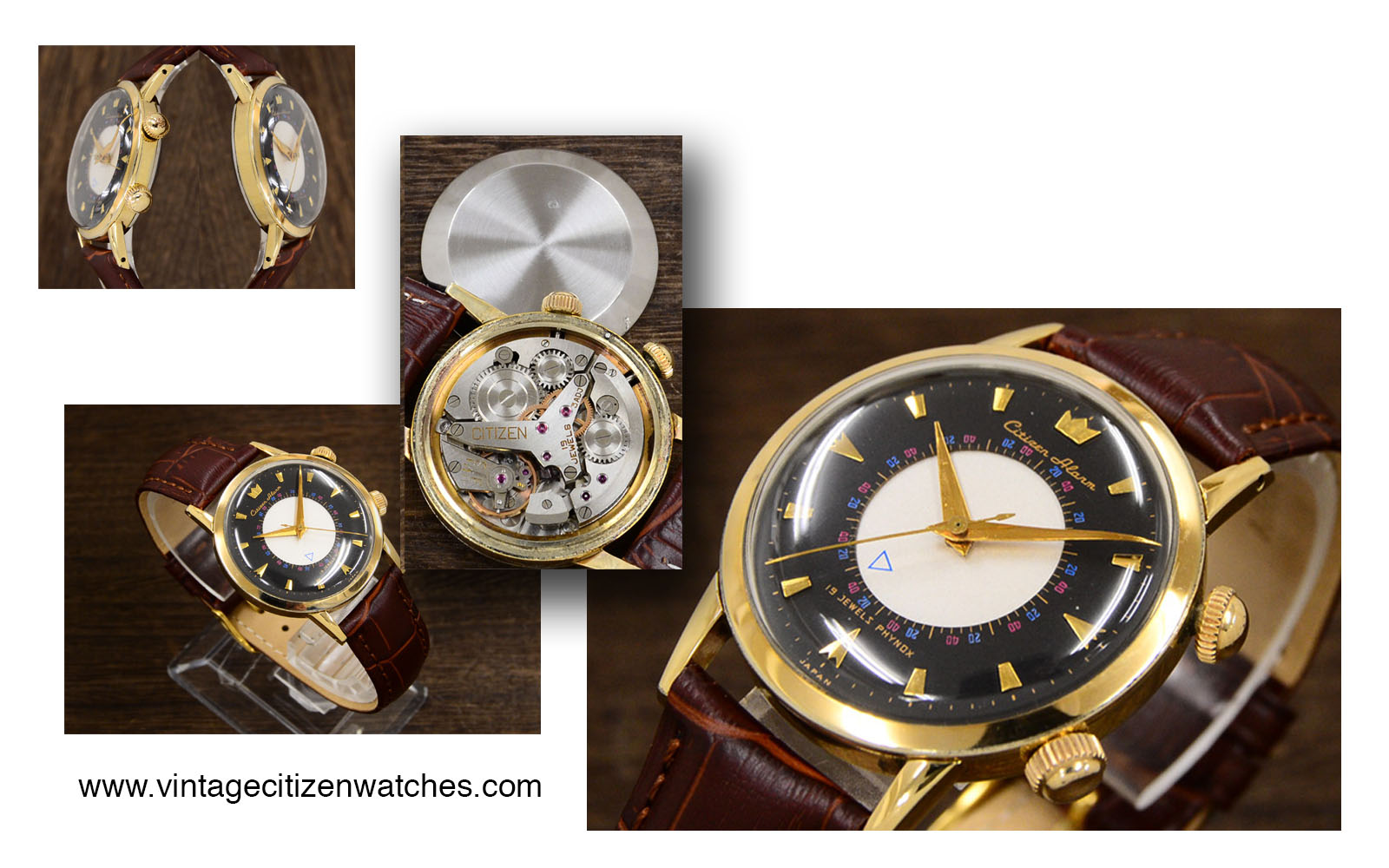
Citizen had three calibers for their alarm watches. The first one, and probably one of the most beautiful timepieces, is this little part of history. Watches powered by this movement were made around 1960. The first one seems to have come out in 1958? making it the first one of a long successful series of alarm watches.

vintage citizen alarm phynox disk

The case is gold filled and has an elegant look, with beautifully shaped lugs and well chosen crowns. Speaking of the crowns, the lower one sets the time and winds the movement. The upper one is for setting the alarm and winds it as well. This is the same for all Citizen alarms. The entire case is polished except for the snap on stainless steel case back that has a central circular brushed surface. The case back can be placed only in a certain position so that the hammer of the movement could strike the pin attached on it. In fact this is how the alarm works. (To hear a Citizen alarm, click this LINK) I like the way the inside of the case back is finished and engraved. The strap is black, original too, and the buckle is, as expected, gold plated (filled?).

The dial is made out of two parts, one central disk that rotates and has a red triangle that is the alarm pointer and the outer part that actually has two concentric shades due to the way it was finished. The hands and the applied hour markers are gold to complete this beautiful look. There is not much text on it except for “Citizen Alarm” and “19 jewels Phynox” and in the lower part “Japan”.

The movement is the most important part of the watch and the reason why this watch is a real success, the first Citizen alarm movement. It is the manual wind Citizen calibre 980, 19 jewels, 3 adj, 18,000 bph. Very beautiful and working like a champ.

citizen alarm disc vintage

The blue central disk watch above has a special case-back, made of two connecting layers, the top part having 6 holes and the entire piece acts like a resonance chamber so the sound of the alarm is really, really loud!

update: another version I found online is this one, black dial with contrasting off-white central disk. Notice the red and blue writing on the dial! Beautiful! The case is gold plated. citizen alarm dick black vintageBottom line, it is a gorgeous watch with a wonderful movement, a real time capsule and one of the most important watches Citizen made. Every collector should have one.

Read more about another simple, no date, vintage citizen alarm watch HERE. The rest of the alarms (date or no date, elegant or sportier) you can find HERE.

Citizen Chronometer


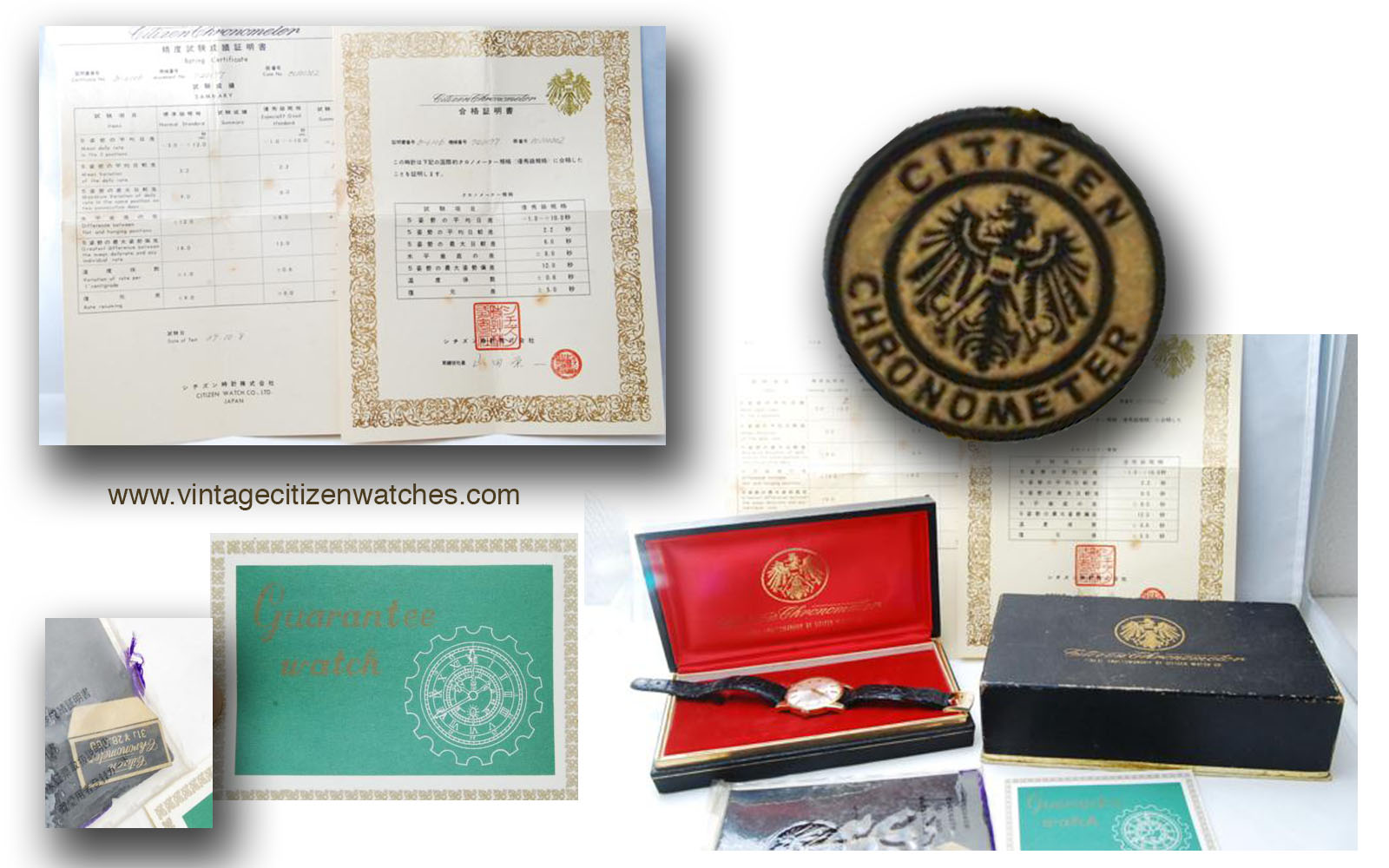
One of the most beautiful vintage Citizen watches ever made is this one, the Citizen Chronomaster. They were made in stainless steel and gold filled cases (also solid gold). Mine is gold filled, as obviously seen in the pictures. citizen chronometer Some say it was born as an answer to Seiko’s Grand Seiko line. Others say it was made to demonstrate a point, that Citizen is capable of great things, so they constructed this awesome time piece, the best one! And it stands its grounds up to this day as both vintage and modern, classy and elegant, powerful watch no matter the reason it was made for in the first place. This model was launched in November 1962 and was produced for about 4-5 years. Being a Chronometer means it has a very high accuracy level, ranging from -1 to +10 s / day. The very large balance wheel and the fine adjustments along with the carefully designed and constructed movement proved it to be the best movement Citizen had at the time. The finishing is great too and even today I find it very pleasing to look at.  It is a hand winding movement (soon after this most of the watches were automatics) and runs at 18.000 bph while having a nice power reserve of about 53 hours. On Citizen page can be found a certificate (the picture below) that proves the quality of the watch, also I fond this solid gold marvel that sold for… over 16,000 USD! vintage citizen chronometerThe case on mine is gold filled (100 microns) and is rather large (and wears even larger) at 36mm diameter. This is mainly due to the large silver dial, small bezel and thick lugs. The crown is signed “C”. The dial is pure beauty, silver with a sunburst effect, with applied gold hour markers and black crisp markings. The three hands are also gold (plated?) The case back snaps on it’s place and is marked both on the outside and inside. The Eagle solid gold medallion is applied and makes the watch even more special. What else is to say? An awesome watch, a joy to wear and a bless to have!

Update Nov 2015:

I have managed to find pictures online with the entire package (not for one watch yet, but this collage is made from different puzzle pieces). So, here it is how the full package (box and papers) should have looked like:

citizen chronometer box papers

Next I will post a picture of the stainless steel one. 🙂

Update Dec 2015: And… here it is:

citizen chronometer stainless steel

And here it is with box and certificate:

citizen chronometer box and papers

Here it is the gold and SS version side by side, not a common sight, is it? 🙂

Awesome piece! So proud to have them!

Citizen center second


Sometimes less is more and this is true when talking about this watch, the first Citizen equipped with a central sweeping hand and not the usual (at that time) eccentric seconds. Starting with this model most of the following watches were like this, without small seconds. So, it was an important milestone in watchmaking.

citizen center secondThe “Center Second” came in many versions, and even a solid gold one, and a total of 6-7 generations for about 10 years. The first one was produced in 1948. All of them were running at 18,000 bph and came  equipped with 7, 8, 9, 10, 11, 15, 16, 17 and even 19 jewels. The Center Seconds are non-hacking and don’t have a date complication. During this time they became water protected and starting from 1956 they had the Citizen Parashock system installed.

The first watch presented here is ParaShock and Water Protected and is made in about 1961. The case back is SS and screws in even though most of them had snap on case backs.  I love the simplicity of the pale white dial with gold accents! The Citizen “C” logo at 12, the hour markers and the hands are all golden while all the rest of the marking are printed in black.

Here are a few pictures from catalogues showing different calibres:

citizen center second

The Center Second had a lot of variations so you can find interesting dial designs, case shapes, hands… etc..  like this beautiful NOS Citizen Junior Center Seconds. (pictures belong to the online seller)

And here it is in a pocket watch form, with original chain attached: citizen pocket watch center secondBottom line, it is an important watch in the Citizen history and a great elegant timepiece itself. Every collector should have one.

Read about more simple Citizen watches HERE.

Citizen automatic skeleton


The Citizen world is a diverse, marvelous place, with divers, chronographs, Leopards, Jet movements, and Chrono Masters and a lot of interesting models. How can anyone not have a skeleton? Well… here it is, one of the interesting ’70s Citizen watches.

citizen automatic skeleton

A large round black case and a skeleton movement, display back and a lot of black and gold accents. It is all about the looks! This watches were first produced in 1971, this particular one being from 1973. The design of the case is the usual one for the period and so is the fact that the case is black. In fact Citizen made a relatively large amount of black cases in the early ’70s. They also designed a lot of beautiful dials and even made watches without one, just like this one. 🙂 Not having a dial doesn’t mean it is an ugly watch but a very interesting one to look at. You can see the movement, the way the crown connects and operates the movement through the stem and flipping the watch over the surprise is that there is a display back so the rotor is in plain sight. The balance wheel is visible through both sides. The entire movement was modified so that all these component can be observed and some parts were blackened and others were given a golden look. I find this color scheme very fortunate.

Some people may like it, others will stick with the more conservative look, with watches having a dial, but no one could argue the fact that this is an interesting watch to wear and look at. Some models were made in stainless steel cases, gold plated or, like this one, black plated ones. At first the Citizen name was stamped on the movement (cal 7290) and later on moved at 6 o clock, on the minute ring (8060). Some of them came with luminous material on the hands, others without. The second hand might be simple, as mine, or might have a luminous dot at the tip. And sometimes it also can be painted red.

The early type movement used was Citizen cal 7290, like mine, with hacking seconds, 21,600 bph. The second movement was the 8060 calibre, 28,800 bph.

Update Dec 2015: Here is my stainless steel one:

citizen skeleton vintage automatic steel

Bottom line, an interesting watch, with a lot of models to chose the favorite from.

Read more about the Leopard watch with a display back HERE.

Citizen Jet Para Water Professional


I was and I still am intrigued by the fact that the lume on Citizen watches doesn’t seem to age like the one on Omega or Rolex or other collectable brands. In fact I lusted for an aged, yellow-brown lume for some time now, on a vintage Citizen and was not able to find a good one. They are either perfect green like new, or, on not well preserved pieces, dirty. It made no sense to me. How can I get a nice patina dial? Finally my dream came true with this awesome timepiece!

The Citizen Jet Para Water Professional

Inside the case back the model no reads: JTI30705I

citizen jet parawater professional

This watch was made in 1962 soon after the introduction of the first water resistant Japanese watch: the Parawater. It also has the Professional label, a rare clasp, a Jet movement and an awesome case back engraving. This was an age when watches had a practical use and not the jewelry that they (sometimes) are today.

The case is made entirely in SS, it is about 37mm and has a simple dial, three hands and no date. The lug hols make changing the original SS bracelet changes so easy! In fact this is a watch that looks good no matter what strap you throw at it: nato, mesh, leather, even rubber. The winding crown is also SS and it is unsigned. At first sight it is very similar with the Parawater I told you about, but this one is not made for water use, but for aviation?. An indication of the link to the aviation is the Jet airplane engraving on the back and the Professional label on the dial. Also a Jet logo is printed on the dial too (Jet movement). In fact the dial has 12, 3, 6 and 9 printed, and the markings: “Citizen Jet, Para Water, Professional”. The hour markers are trapezoidal,  raised and polished. They are filled with (now) the beautifully aged luminous material and so are the matching dauphine hands. All things considered it is a beautiful, simple, balanced face that I like a lot! I have seen very few examples of this model and some of them have an arrow shaped hour hand and a thicker minute one with a flat tip.

The movement is the usual Jet movement with a circular swinging rotor. It runs at 18,000bph as all of them do. This one is the first one made, launched a few months earlier, in October 1961. My watch in made (3-4 months later) in March 1962. It is an automatic (hand winding also possible) with non hacking sweeping central seconds hand. It is called Citizen calibre 3010, Jet movement, and was the first movement that Citizen produced in relatively high numbers. The interesting fact about the rotor is that in earlier types it is marked “Automatic” rather than the usual “Autodater”. The date was added a year later, and so did the name “Autodater”.

And to add to the story… the clasp is marked: “Easy-O-Matic, Citizen Band, Pat.Pend. Stainless Steel” making it even more interesting if that was even possible. 🙂

Citizen auto Dater UNI – ADUS31201-T


It may not be a real diver but what a gorgeous watch it is! It was made in 1964, just 5 years after the introduction of the first Japanese water resistant watch, the Parawater, and about one year prior to the first real diving watch made by Citizen.

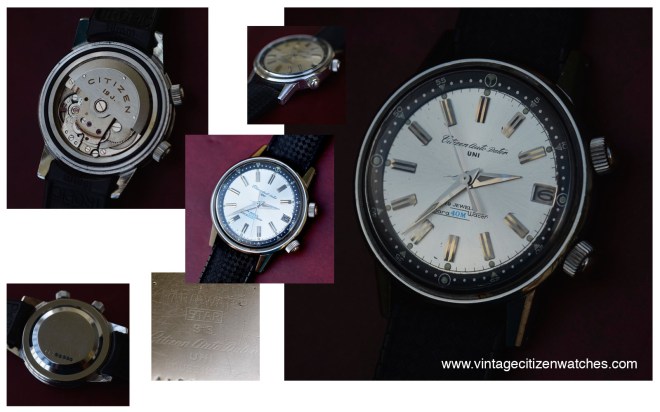
Let me introduce to you the Citizen auto Dater UNI reference ADUS31201-T
citizen autodater uni

The main feature of the watch is the fact that it is a twin crown, similar in appearance with a compressor. The upper crown, located at 2 o’clock, operates the inner bidirectional rotating bezel. By contrast, the lower crown located at 4 o’clock winds the movement and sets the time. The case is made entirely in polished stainless steel and measures about 38mm. The Tropic strap is 18mm at the lugs end and is secured in place by pins that can be easily removed due to the holes in the lugs (a feature that I like a lot in vintage watches). Hopefully one day I will find one on original bracelet. Will see.

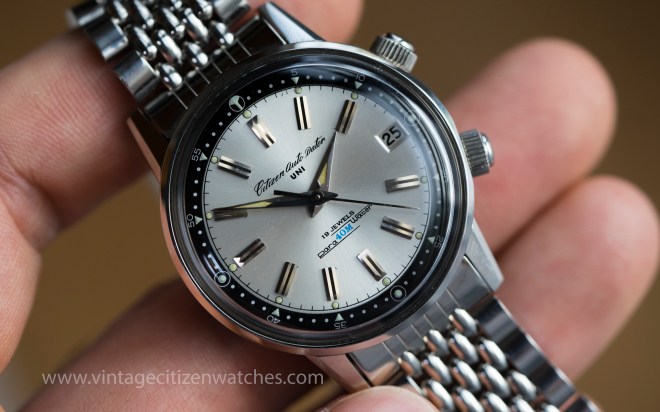
The domed acrylic crystal protects the beautiful face. The dial is silver, having a sunburst effect. The doubled hour markers are polished and applied. The black elegant lettering are printed and so is the “40M” blue para water feature. The dauphine hands are polished and the hour and minute one have a central luminous part. The inner black rotating bezel has white printing and luminous material markers. On the dial itself the hours are marked with luminous dots too; all except the one at 3 where the date is. The date window has no frame but instead a beveled edge. The dates are printed in black on a white date wheel. I just love the way it looks! It is one of those beautiful watches, elegant and easy to wear.
citizen uni cal 2400 auto dater

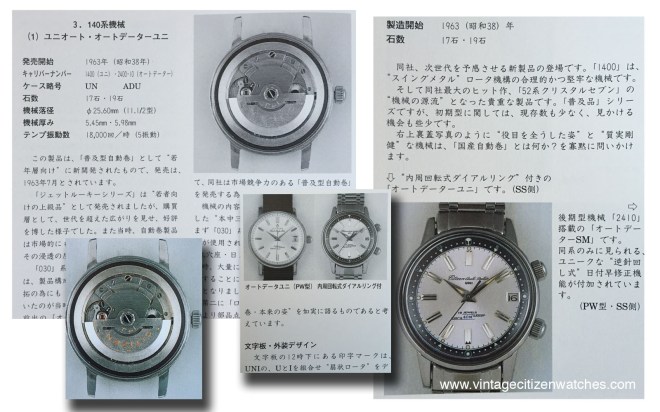
The snap in case back is engraved “Para water,  Star, SS, Citizen auto Dater, UNI, ADUS31201-T” and the serial no. Strangely Citizen decided to mark them with the production date and so did they do it on older ones but not on their first divers. 😦 I wish I could say for sure when the first real diver made by Citizen was manufactured. Under the case back we have the automatic (hand winding also possible) Citizen 19 jewels movement, cal 2400. In the early till mid 1960’s Citizen used its own circular geared rotor (Jet rotor movements) in its automatic watches.  In 1963 they began replacing the Jet rotor with the more common oscillating weight, which, some say it was cheaper to manufacture and more easily to service than the Jet rotor. The first model to use the swinging weight was known as the “Uniauto” (cal 1200) and came in several versions, all with a special logo on the dial and in 17 or 19 jeweled versions. This watch, presented here, has the logo on the inner bezel at 12. It works at 18,000bph. The date changes by advancing the hour hand past midnight. The seconds hand do not hack.

Still I have to find out why is it called “UNI”?

UPDATE 2019 JUNE (5 years later)

I sold my UNI, the one in the picture above, a while ago and since then I was looking for another one, and as you already know me, I am always trying to get the best condition, NOS and mint if possible. Well… with UNI this was not an easy search. It took me a few good years, but I finally nailed it yesterday with Eric’s help! (Happy birthday my friend!) Here it is, my new UNI: (the picture credit goes to the seller, I am still waiting for my beautiful watch to get in my hands, really soon I hope) As you can see it is NOS, on a bracelet and comes with the original box! I am really happy about it!

How I wish Citizen will go vintage style again! Who knows, maybe one day…

And one more pic:
UPDATE 2021 Oct:

I was following an auction of a rare variant, black dial one, and it sold at a high price. It was to be expected because it is really rare and rare usually means money. I don’t like it as much as the variant I have and it was not NOS so I didn’t bid. But… what an awesome piece!
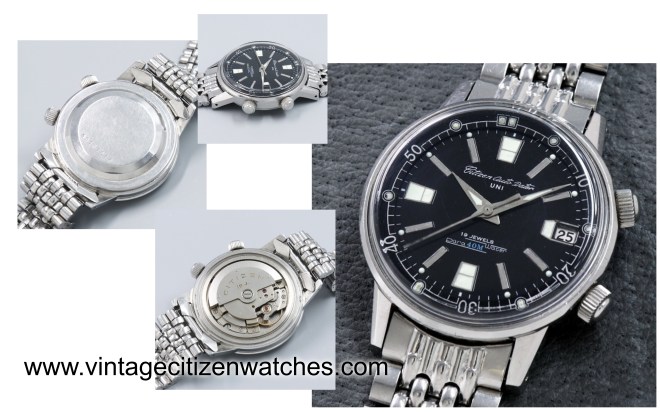
citizen uni black dial

Meanwhile, read more about a different diver compressor style vintage Citizen here.